
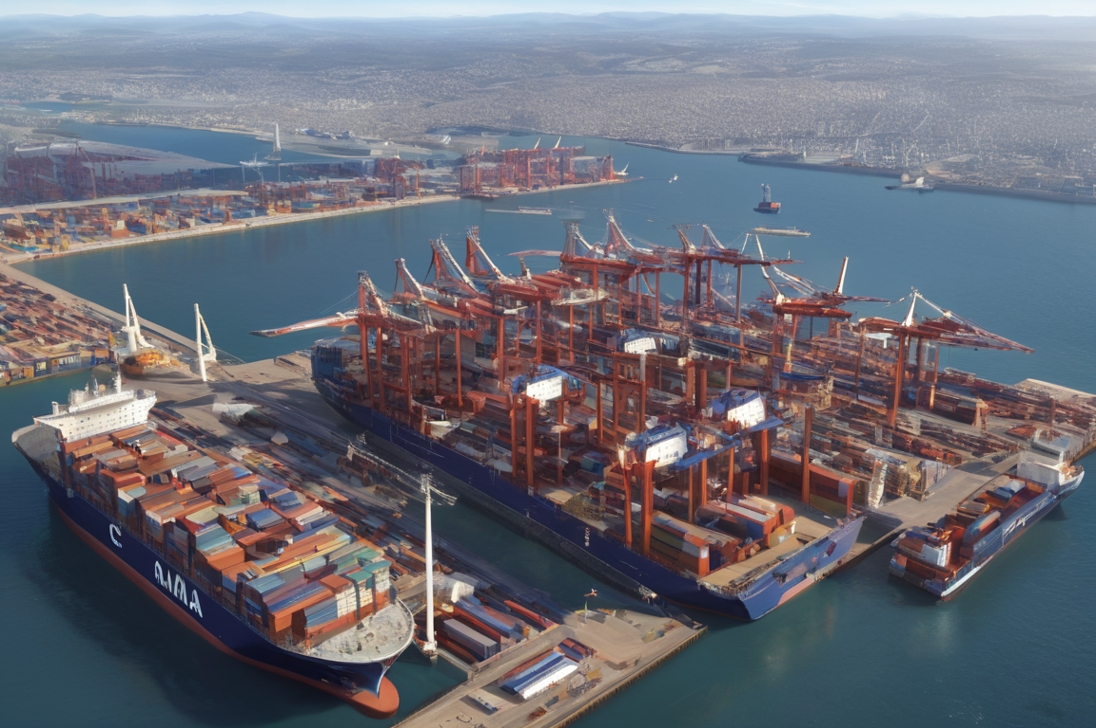
The busiest port on the East Coast demonstrates its power as it seeks to capture a larger share of massive profits and multibillion-dollar land deals passing through the shipping industry.
The Port of New York and New Jersey is aiming to gain a slice of the transactions involving the buying and selling of terminals, seeking a greater share of revenues from the business passing through its docks. This also requires tenants engaged in cargo handling to invest more of their own funds in infrastructure upgrades.
The port's more aggressive approach is taking shape as ocean carriers report sharp profit increases, and multinational companies spend billions of dollars acquiring valuable space in major ports. French company CMA CGM purchased two terminals in the Port of New York and New Jersey last year for $2.8 billion, one of the largest deals in recent years, akin to a land rush at global gateways.
The Port of New York and New Jersey, tied to long-term lease agreements, is aiming to sell terminals and extend leases to generate more revenue from large volumes of goods moved through maritime trade.
Like other ports around the world, the port earns revenue through leasing agreements with various private terminal operators. Lease agreements provide a stable source of income, but the port does not profit when cargo volumes surge dramatically.
The value of cargo facilities has risen with the expansion of global trade, and large terminal operators are eager to secure ownership of container terminals. Major shipping companies, including CMA CGM, Denmark's A.P. Moller-Maersk, and Switzerland's Mediterranean Shipping, are investing in more port facilities to gain greater control over the goods moved through their transportation networks.
The lease term for two of the largest terminals at the Port of New York and New Jersey expires in the coming years, including the lease for the Maher terminal, the port's most valuable asset. The current tenant of Maher, Australian infrastructure fund giant Macquarie Asset Management, is in talks to extend the deal to either upgrade the terminal or sell it.
Shipping industry representatives note that the potential sale of Maher, which could happen as soon as next year, is drawing interest from some of the world's largest ocean carriers, infrastructure funds, and terminal operators. According to observers, the property could generate billions of dollars from a sale.
"This is the largest terminal in the largest port on the East Coast and the gateway to one of the largest consumer markets in the world," said Matthew Leach, CEO of Ports America, the operator of one of the port's other terminals.
The port is also in talks with APM Terminals, a subsidiary of Maersk, which operates a terminal in Elizabeth, New Jersey, according to a person familiar with the matter. Its lease term expires at the end of 2029.
Representatives of Maersk and the state agency managing the port declined to comment.
Cargo-handling terminals are in high demand as terminal operators and infrastructure funds chase prized assets, while ocean carriers are spending billions to acquire terminals and gain more control over the land-side operations of their ships.
In 2022, CMA CGM bought a 90% stake in its partner Fenix Marine Services, one of the largest terminals at the Port of Los Angeles, with an enterprise value of $2.3 billion. Chinese company Cosco Shipping Ports has expanded its terminal operations globally alongside the growth of the state-owned Cosco Shipping Lines, acquiring stakes this year in terminals at Thailand's busiest port and opening a $3.5 billion mega port in Peru.
The Port of New York and New Jersey serves as a key gateway for imports into the Northeast United States. In the first nine months of this year, the port processed the equivalent of nearly 6.6 million containers, up 13.8% from the same period in 2023.
Striking dockworkers closed the port for three days in October as part of a broader labor protest by union workers at ports from Maine to Texas. Importers and exporters fear the dockworkers may strike again if a long-term deal is not reached by the January 15 deadline.
The port's more decisive strategy on terminals was evident in the concessions it received from the sale of two terminals to CMA CGM last year.
The carrier paid the Canadian company Global Container Terminals $2.8 billion for assets in New Jersey and Staten Island, according to financial documents from CMA CGM. As part of the deal, the port received a fee of $20 million, according to a person familiar with the transaction.
CMA CGM agreed to pay higher lease rates based on container throughput capacity and to pay a share of the fees for storing containers beyond the base amount. The company also agreed to invest $600 million in dock infrastructure, including repairs to piers and wharfs.
Shipping industry representatives note that the port's ambitions have grown since the COVID pandemic, when a surge in demand for ocean freight brought enormous profits to the shipping industry.
According to maritime consulting firm Sea-Intelligence, shipping companies collectively earned over $400 billion between 2021 and 2022, roughly 10 times their combined operating profits over the previous decade. According to Sea-Intelligence, after a drop in profits last year, ocean carriers earned over $17 billion in the most recent quarter, seven times more than in the same period the previous year.